
Table of Content
- Introduction
- Image
- Background / Context
- Detailed Technical Breakdown
- Strategic Importance
- Real-World Examples
- Expert-Level Analysis
- Future Warfare Impact
- Comparison Section
- Key Takeaways
- Conclusion
- FAQ
Introduction
How Sensor Fusion Is Redefining Air Combat and Air Superiority, In March 2026, during a classified U.S. Air Force test over the Nevada Test and Training Range, a single NGAD crewed fighter fused data from its own AESA radar, distributed aperture system, four Collaborative Combat Aircraft (CCA) loyal wingmen, overhead satellites, and ground-based sensors to simultaneously detect, classify, and engage 27 simulated threats in under 11 seconds — all while operating in heavy electronic warfare conditions. The pilot never touched a targeting pod or manually designated a single target. The system did it autonomously, with the pilot retaining final human-on-the-loop approval.
This single test encapsulated the revolution now underway: sensor fusion in air combat has moved from a supporting technology to the decisive enabler of air superiority in 2026. No longer is victory determined by who has the stealthiest or fastest fighter. Victory now belongs to the force that can fuse the greatest volume of multi-domain data fastest, turn it into actionable insight, and act before the adversary can respond.
Sensor fusion in air combat integrates inputs from radar, infrared, electronic support measures, electro-optical, synthetic aperture radar, off-board loyal wingmen, space-based assets, and cyber-derived intelligence into a single, real-time battlespace picture. When powered by air combat AI integration, it compresses the OODA loop to seconds and enables multi domain air power strategy at machine speed.
This article provides a comprehensive, evidence-based strategic analysis of how sensor fusion is redefining air combat and air superiority in modern warfare. It examines the technology, current programs, leadership dynamics among USA, China, Russia, and others, real-world lessons, doctrinal shifts, and the 2025–2035 battlefield implications. For military planners, defense contractors, and think tanks, understanding this shift is now non-negotiable.
For context on supporting autonomous and cyber systems, see our recent articles:
- How Drone Swarm Warfare Works: Tactical Advantages & Counter-Drone Strategies in 2026
- Can Autonomous Combat Drones Replace Fighter Jets? Future Air Warfare Explained
- Why Cyber Resilience Will Define Military Strategy by 2030
- What Are Sixth-Generation Fighter Jets? Future Air Combat Capabilities Explained
Background / Context
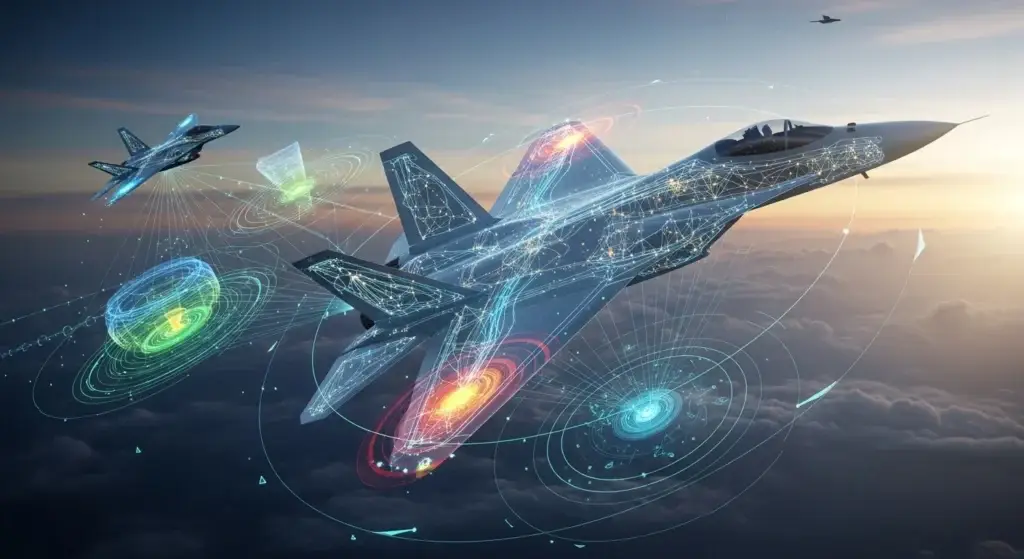
Traditional air combat relied on single-platform sensors. Fifth-generation fighters (F-35, J-20) introduced initial sensor fusion, but 2026 sixth-generation systems take it to an entirely new level. Sensor fusion in air combat now means real-time fusion of hundreds of thousands of data points per second from distributed sources across all domains.
The doctrinal driver is clear: in contested airspace, no single sensor survives. The winner is the platform that can fuse degraded or denied sensor feeds fastest and maintain a coherent battlespace picture. This capability directly supports air superiority doctrine 2026, integrated air defense systems comparison, and stealth vs counter stealth technology dynamics.
Major programs driving this revolution in 2026:
- U.S. NGAD + CCA family
- UK/Italy/Japan GCAP (Tempest)
- France/Germany/Spain FCAS
- China J-XX / GJ-11 ecosystem
- Russia PAK DP (limited progress)
All share one core philosophy: the crewed fighter is now a command node, not the primary sensor or shooter.
Detailed Technical Breakdown
How Sensor Fusion Works in 2026 Air Combat
Sensor fusion in air combat operates through three layered processes:
- Data Ingestion Layer Onboard AESA radars, distributed aperture systems (DAS), infrared search and track (IRST), electronic support measures (ESM), synthetic aperture radar (SAR), and off-board feeds from loyal wingmen, satellites, and ground nodes.
- AI Processing & Correlation Layer, Air combat AI integration uses deep neural networks and reinforcement learning to correlate, deconflict, and prioritize data. Algorithms predict adversary intent and generate targeting solutions in real time. DARPA’s ACE program (2025 tests) showed 70–80% workload reduction for pilots.
- Output & Decision Layer A unified battlespace picture is presented to the pilot via helmet-mounted displays or cockpit tablets, with autonomous recommendations for engagement. The pilot retains human-on-the-loop authority for lethal decisions.
Key 2026 enablers include:
- Adaptive waveform AESA radars (frequency agility to defeat jamming)
- Quantum-resistant datalinks for secure off-board fusion
- Edge AI chips capable of processing petabytes in contested environments
- Multi-spectral stealth vs counter-stealth countermeasures (plasma, metamaterials, dynamic signature management)
These technologies make next generation fighter capabilities far more than incremental improvements — they create a qualitative leap in air superiority.
For deeper technical modeling of fusion algorithms, see the RAND Corporation study on sensor fusion in future airpower.
Strategic Importance
Sensor fusion in air combat redefines air superiority because it turns information into the ultimate weapon. A force with superior fused awareness can:
- Detect and engage threats before they detect it
- Coordinate multi-domain effects (air, space, cyber, EW) at machine speed
- Maintain operational tempo even when individual sensors are jammed or destroyed
This capability directly impacts air superiority doctrine 2026 and multi domain air power strategy. Nations that master it gain decisive advantage in peer conflicts. For mid-tier powers, advanced sensor fusion offers asymmetric leverage — allowing smaller fleets to punch above their weight against larger adversaries.
Doctrinally, air forces are moving from “platform-centric” to “network-centric” and now “AI-centric” models. The fighter is no longer the sensor; it is the orchestrator. This shift mirrors the revolution already seen in drone swarm warfare and autonomous systems.
Real-World Examples
Ukraine Conflict 2022–2026: Sensor Fusion in Practice
Ukrainian forces demonstrated early sensor fusion by integrating commercial Starlink, NATO-provided intelligence, drone feeds, and ground radars into a unified picture. This allowed effective targeting despite Russian jamming. Russian forces countered with their own fused systems on Su-30/Su-57 platforms. The side with better real-time fusion consistently achieved higher strike success rates. Detailed operational insights are covered in the IISS Strategic Dossier on Sensor Fusion in Ukraine 2026.
Expert-Level Analysis
Strengths
- Unmatched situational awareness in contested environments
- Reduced pilot workload and increased decision speed
- Synergistic effect with loyal wingmen and autonomous systems
Weaknesses & Limitations
- Extreme data processing demands
- Vulnerability to AI spoofing and advanced electronic warfare
- High cost and complexity of integration
Countermeasures
- Dynamic signature management and adaptive waveforms
- AI-driven deception techniques
- Redundant multi-path fusion architectures
For rigorous quantitative analysis of these trade-offs, refer to the CSIS report on sensor fusion and future air superiority.
Future Warfare Impact
By 2030–2035, sensor fusion will enable fully distributed air combat clouds where no single platform is the “brain.” Future air warfare systems will fuse data across hypersonic, space, and cyber domains at machine speed.
Future warfare prediction: In a 2035 Pacific scenario, Chinese J-XX platforms with GJ-11 swarms will attempt to create a sensor-denied “air hellscape.” U.S. NGAD + CCA teams, leveraging superior sensor fusion in air combat and air combat AI integration, will counter by maintaining a coherent battlespace picture and directing effects from standoff distances. The side that sustains fused awareness longest will dictate the tempo of the entire campaign.
Global investment in advanced sensor fusion technologies is projected to exceed $180 billion cumulatively by 2035.
Comparison Section: Sensor Fusion Capabilities 2026–2035
| Program / Nation | Fusion Maturity | Off-Board Integration | AI Decision Speed | Stealth vs Counter-Stealth | Projected Air Superiority Edge |
|---|---|---|---|---|---|
| USA NGAD | Very High | 8–12 CCAs | Machine speed | Dynamic + adaptive | Leading |
| China J-XX | High | 6–10 loyal wingmen | Very High | Aggressive counter-stealth | Strong challenger |
| UK/Italy/Japan GCAP | High | 4–8 wingmen | High | Collaborative | Strong |
| France/Germany/Spain FCAS | High | 4–8 wingmen | High | Digital twin focus | Competitive |
| Russia PAK DP | Medium | Limited | Medium | Legacy focus | Lagging |
Key Takeaways
- Sensor fusion in air combat is the decisive capability for air superiority in 2026 and beyond.
- Sixth-generation fighters succeed as command nodes, not lone wolves.
- Air combat AI integration and multi domain air power strategy amplify every platform’s effectiveness.
- USA leads in fusion maturity and integration; China leads in scale and counter-stealth aggression.
- Stealth vs counter stealth technology is now a continuous arms race.
- Nations must invest in loyal wingmen, adaptive sensors, and resilient AI architectures immediately.
- Human oversight remains essential for ethical and strategic decisions.
Conclusion
Sensor fusion in air combat has fundamentally redefined air superiority. The fighter that sees first, understands fastest, and acts with precision through fused multi-domain data will dominate the skies of 2030–2035. Standalone platforms are obsolete; the future belongs to networked, AI-augmented families of systems where the crewed sixth-generation fighter serves as the irreplaceable human command node.
The global race is accelerating. Nations that master sixth generation fighter analysis, next generation fighter capabilities, air superiority doctrine 2026, and future air warfare systems will write the rules of the next era of conflict. Those that lag will find themselves strategically blindfolded in the most contested airspace in history.
FuturWave.com remains the authoritative global platform for future warfare analysis. Defense leaders, industry executives, and strategic thinkers seeking detailed sensor fusion assessments, scenario modeling, or customized integration briefings are invited to engage directly — the sensor fusion revolution in air combat is already here, and the winners are being decided now.
What is sensor fusion in air combat and why does it matter in 2026?
Sensor fusion integrates data from multiple onboard and off-board sensors into a single coherent battlespace picture, enabling machine-speed decisions and true multi-domain air power strategy.
How does sensor fusion differ in sixth-generation vs fifth-generation fighters?
Sixth-generation platforms fuse data from loyal wingmen, space assets, and cyber sources at machine speed with adaptive AI, while fifth-generation relies primarily on onboard sensors.
Which country leads sensor fusion development in 2026?
The United States leads in maturity and integration (NGAD + CCA); China leads in scale and aggressive counter-stealth applications.
Can sensor fusion overcome advanced electronic warfare and jamming?
Yes — through adaptive waveforms, AI-driven correlation, and redundant off-board fusion paths. This is a core focus of all sixth-generation programs.
What will air superiority look like in 2035?
Distributed sensor-fused air combat clouds where crewed fighters command autonomous wingmen, maintaining superiority through superior awareness rather than individual platform performance.
