
Table of Content
- Introduction
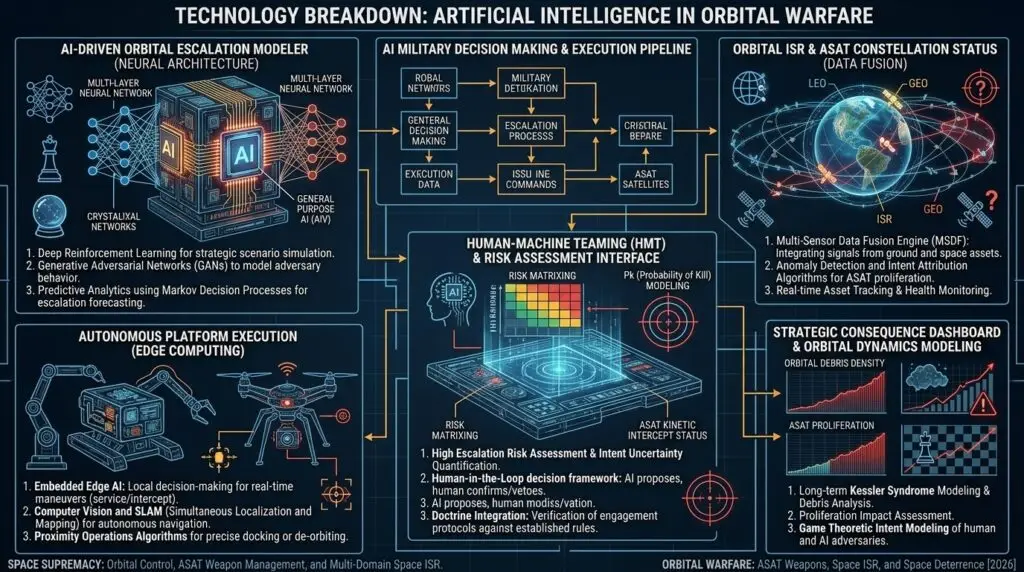
- Image
- Background / Context
- Detailed Technical Breakdown
- Strategic Importance
- Real-World Examples
- Expert-Level Analysis
- Future Warfare Impact
- Comparison Section
- Key Takeaways
- Conclusion
- FAQ
Introduction
In the closing months of 2025 and the first quarter of 2026, three landmark events quietly reshaped the global military landscape. First, the U.S. Department of Defense confirmed that its AI Acceleration Strategy had moved Project Maven’s advanced targeting algorithms into operational use across multiple combatant commands. Second, Chinese state media released verified footage of DeepSeek-powered drone swarms conducting fully autonomous coordinated strikes during a large-scale PLA exercise in the South China Sea. Third, Russian forces in Ukraine deployed the upgraded Svod AI tactical awareness system at battalion level, achieving reported 80% strike accuracy improvements in real-time engagements.
These developments are not isolated experiments — they represent the tipping point where artificial intelligence in warfare stopped being a supporting tool and became the central nervous system of modern military operations. AI military integration in 2026 is no longer about faster data processing; it is about compressing the OODA loop from minutes to seconds, enabling autonomous decision-making at scale, and fundamentally altering how nations project power.
The question defense leaders must now answer is no longer “Should we adopt AI?” but “How fast and how deeply must we integrate military artificial intelligence to survive the next conflict?” Nations that master AI military strategy 2026, AI decision making battlefield, autonomous weapons strategic impact, AI-enabled targeting systems, AI multi domain operations, and AI battlefield integration will hold decisive advantage. Those that lag will face strategic paralysis before the first kinetic round is fired.
This article delivers a deeply researched, forward-looking strategic analysis of revolutionizing artificial intelligence in warfare and AI military integration in 2026. It examines current capabilities, leadership dynamics among the USA, China, and Russia, real-world deployments, doctrinal shifts, risks, and the 2025–2035 battlefield implications. For military planners, defense contractors, think tanks, and policymakers, this is the definitive reference point on the new reality of warfare.
For context on complementary systems that rely on this AI backbone, see our previous analyses:
- How Drone Swarm Warfare Works: Tactical Advantages & Counter-Drone Strategies in 2026
- Can Autonomous Combat Drones Replace Fighter Jets? Future Air Warfare Explained
- Why Cyber Resilience Will Define Military Strategy by 2030
- What Are Sixth-Generation Fighter Jets? Future Air Combat Capabilities Explained
Background / Context
Artificial intelligence in warfare refers to the integration of machine learning, reinforcement learning, neural networks, and large language models into every layer of military operations — from strategic planning to tactical execution. Unlike earlier automation, 2026-era military artificial intelligence operates at autonomy levels 4–5, enabling systems to make independent decisions within human-defined rules while continuously learning from real-world data.
The acceleration began with the U.S. Project Maven in 2017 and China’s 2017 New Generation AI Development Plan. By 2025–2026, geopolitical pressure and rapid technological progress turned these concepts into operational reality. Key drivers include:
- Explosion of battlefield data (petabytes generated daily in Ukraine-style conflicts)
- Maturation of edge AI chips capable of running complex models in contested environments
- Convergence of AI with other domains (cyber, space, electronic warfare)
- Doctrinal recognition that decision speed now equals lethality
Major powers have responded differently. The USA emphasizes ethical, human-centric integration through the DoD AI Ethical Principles (updated 2025). China pursues “intelligentized warfare” with state-driven scale. Russia focuses on tactical AI enhancements despite sanctions. These divergent paths have created a clear leadership hierarchy that will define global power balances through 2035.
Detailed Technical Breakdown
Core Technologies Driving AI Military Integration in 2026
Autonomous Decision-Making Agentic AI models using hierarchical reinforcement learning now generate multiple courses of action in seconds. U.S. systems like the Air Force’s ACE (Air Combat Evolution) and Army’s Project Convergence demonstrate real-time scenario simulation and recommendation. In 2026, these models process multi-domain data (ISR, cyber, EW) to compress kill chains from hours to minutes.
AI-Powered ISR (Intelligence, Surveillance, Reconnaissance) Computer vision and predictive analytics fuse satellite, drone, and sensor feeds. Project Maven’s evolution now achieves 92% accuracy in target identification with sub-second processing. China’s equivalent systems integrate social media signals and open-source intelligence at scale, giving PLA commanders unprecedented situational awareness.
Human-in-the-Loop vs Human-on-the-Loop Architectures HITL requires human approval for lethal actions (U.S. policy standard). HOTL allows AI autonomy with override capability (favored in high-tempo scenarios). The 2026 U.S. DoD directive mandates hybrid models, balancing speed with accountability. China pushes HOTL more aggressively in training exercises.
AI-Enabled Targeting Systems Deep learning algorithms predict enemy movements and prioritize high-value targets. Russia’s Svod system in Ukraine achieved 80% strike accuracy improvements in 2025–2026. These systems integrate with autonomous weapons strategic impact, allowing preemptive strikes while maintaining military AI vs human command oversight.
AI Multi Domain Operations & Battlefield Integration AI now orchestrates joint effects across air, land, sea, space, and cyber. The U.S. Joint All-Domain Command and Control (JADC2) initiative reached Initial Operational Capability in late 2025, linking sensors and shooters in real time.
These technologies form the foundation of future of AI warfare systems that will dominate the next decade.
Strategic Importance
AI military integration in 2026 delivers “decision dominance” — the ability to observe, orient, decide, and act faster than any adversary. In peer conflicts, this advantage translates directly into victory. A force that compresses its OODA loop by 70% can preempt enemy moves, saturate defenses, and maintain operational tempo even under heavy attrition.
For global defense, including mid-tier powers, the implications are stark. Nations that fail to integrate AI military strategy 2026 risk strategic irrelevance. Conventional platforms without AI augmentation become liabilities in environments dominated by autonomous swarms and AI-enabled targeting. AI battlefield integration turns low-cost assets (drones, loitering munitions) into high-impact force multipliers, leveling the playing field against numerically superior opponents.
Doctrinally, militaries are shifting from platform-centric to system-of-systems models. The human commander remains the ethical and strategic apex, but AI handles the volume and speed of modern warfare. This evolution is irreversible and will define military effectiveness through 2035.
Real-World Examples
Ukraine Conflict 2022–2026: AI as Force Multiplier
Ukrainian forces integrated AI targeting and autonomous drone coordination at scale. The Svod system and Western-supplied AI tools enabled 80% strike accuracy improvements despite Russian electronic warfare. U.S. Claude models assisted planning in multiple operations, demonstrating AI decision making battlefield in real time. Russia responded with its own AI-enhanced Lancet swarms. This laboratory proved that AI military integration can offset conventional disadvantages.
For detailed case studies, see the International Institute for Strategic Studies (IISS) Strategic Dossier on AI in Ukraine 2026.
U.S. Operations in Middle East (2025–2026)
U.S. forces employed advanced Maven-derived AI for targeting in high-tempo operations against Iran-linked targets. Systems processed thousands of targets daily, compressing kill chains while maintaining human oversight. This demonstrated scalable AI-enabled targeting systems in contested environments.
Expert-Level Analysis
Strengths
- Unprecedented decision speed and accuracy
- Force multiplication through autonomous systems
- Persistent operations in degraded environments
Weaknesses & Limitations
- Algorithmic bias and brittleness in novel scenarios
- Heavy dependence on data quality and compute power
- Escalation risks from autonomous lethal decisions
Countermeasures
- Rigorous red-teaming and human-on-the-loop safeguards
- Diversified AI models and robust cybersecurity
- International norms on lethal autonomy (ongoing REAIM and CCW discussions)
For quantitative risk modeling, refer to the RAND Corporation report on military AI adoption.
Future Warfare Impact
By 2030–2035, AI military integration will enable hyperwar — conflicts decided in hours rather than weeks. Agentic AI networks will orchestrate multi-domain operations at machine speed, with humans providing strategic direction and ethical oversight.
Future warfare prediction: In a 2035 high-intensity conflict, the side that maintains functional AI-driven C2 longest will dominate all domains. Chinese “intelligentized warfare” doctrine combined with mass autonomous systems will challenge U.S. technological superiority, forcing hybrid human-AI command structures. Global military AI spending is projected to reach $33.6 billion annually by 2035 (SIPRI estimates). Nations that fail to invest now will face decisive disadvantage.
For deeper modeling of these scenarios, see the CSIS analysis on AI-driven future warfare.
Comparison Section: AI Military Integration Leadership 2026–2030
| Nation | Autonomy Level | Scale & Production | Battlefield Experience | Ethical Framework | Overall Position 2030 |
|---|---|---|---|---|---|
| USA | 4–5 | High (private sector) | Limited peer conflict | Strong (DoD principles) | Leading in maturity |
| China | 4+ | Very High (state-driven) | Growing (South China Sea) | State-centric | Leading in scale & speed |
| Russia | 3–4 | Medium | High (Ukraine) | Tactical focus | Strong tactically, lagging technically |
Key Takeaways
- Artificial intelligence in warfare has become the decisive domain enabler by 2026.
- AI military strategy 2026 and AI decision making battlefield compress kill chains dramatically.
- USA leads in ethical integration and software maturity; China leads in scale and deployment speed.
- Human oversight remains essential for lethal decisions and strategic adaptation.
- AI battlefield integration turns autonomous weapons into force multipliers.
- Nations must accelerate investment in resilient AI architectures, data infrastructure, and human-AI teaming now.
- Ethical and escalation risks demand new international norms.
Conclusion
Revolutionizing artificial intelligence in warfare through deep AI military integration in 2026 has permanently altered the character of conflict. The integration of autonomous weapons strategic impact, AI-enabled targeting systems, AI multi domain operations, and future of AI warfare systems has shifted victory conditions from platform superiority to decision superiority and system resilience.
The nations that most effectively balance machine speed with human judgment will dominate the battlespaces of 2030 and beyond. The window for catching up is closing rapidly. Those who delay investment in military artificial intelligence and AI defense systems risk strategic obsolescence in the digital and autonomous era.
FuturWave.com remains the global leader in authoritative, forward-looking defense analysis. Defense organizations, governments, and industry leaders seeking detailed AI integration assessments, scenario modeling, tabletop exercises, or customized strategic briefings are invited to connect directly — the AI military revolution is already underway, and the winners are being decided now.
What is artificial intelligence in warfare and its role in future warfare?
Artificial intelligence in warfare leverages military artificial intelligence to enhance AI military decision making, autonomous weapons, and AI battlefield systems, driving battlefield technology advancements in future warfare.
How does military technology integrate autonomous weapons in artificial intelligence in warfare?
Military technology in artificial intelligence in warfare embeds autonomous weapons with AI military strategy, promoting military innovation through next generation weapons and defense technology.
What does AI military technology future entail for artificial intelligence in warfare?
AI military technology future in artificial intelligence in warfare predicts sophisticated AI weapons systems redefining future warfare with core AI in modern warfare elements.
Explain AI battlefield systems in artificial intelligence in warfare.
AI battlefield systems in artificial intelligence in warfare utilize military artificial intelligence for ISR, amplifying defense technology and AI military strategy in modern warfare.
What risks are associated with AI military strategy in artificial intelligence in warfare?
AI military strategy in artificial intelligence in warfare includes bias and escalation risks, addressed via ethics in military innovation, next generation weapons, and battlefield technology.
What does AI military integration mean in 2026?
It means embedding machine learning and agentic AI into command, targeting, ISR, and multi-domain operations to compress decision cycles while maintaining human oversight.
Can AI fully replace human command in warfare?
No. Current doctrine and ethical frameworks require human-on-the-loop or human-in-the-loop for lethal decisions. AI excels at speed and volume but lacks creative judgment and ethical reasoning.
Which country leads AI military integration in 2026?
The USA leads in maturity, ethical frameworks, and software integration. China leads in scale, production speed, and operational experimentation.
What are the biggest risks of AI military integration?
Algorithmic bias, cyber vulnerabilities, loss of human control in escalation scenarios, and over-reliance on opaque AI recommendations.
How should militaries prepare for AI-driven warfare by 2030?
Invest in resilient zero-trust architectures, AI red-teaming, quantum-secure communications, human-AI teaming training, and international norm-building on lethal autonomy.