able of Content
- Introduction
- Image
- Background / Context
- Detailed Technical Breakdown
- Strategic Importance
- Real-World Examples
- Expert-Level Analysis
- Future Warfare Impact
- Comparison Section
- Key Takeaways
- Conclusion
- FAQ
Introduction
In February 2026, the U.S. Navy’s Sea Hunter autonomous surface vessel, now under full fleet control, successfully completed its first integrated mission with a carrier strike group in the Indo-Pacific. Using onboard AI, it autonomously detected, tracked, and simulated engagement of multiple simulated threats while relaying fused data to the carrier’s command center in real time. At the same time, China commissioned the Type 076 “Sichuan” — the world’s first drone-carrying amphibious assault ship with electromagnetic catapult capability — and Ukraine field-tested its next-generation ocean-going naval drones capable of operating thousands of kilometers from shore.
These three events in early 2026 confirm that AI is transforming naval warfare at an unprecedented pace. Naval AI integration has moved beyond experimental status to become the core operating system of future maritime combat. Autonomous naval vessels warfare, maritime domain awareness technology, and AI-driven decision loops are now redefining carrier strike group modernization, submarine deterrence doctrine, anti-ship missile systems analysis, and sea control doctrine 2030.
Future naval warfare systems will no longer revolve around traditional manned hulls alone. Instead, hybrid fleets of AI-enabled autonomous warships will provide distributed lethality, persistent presence, and affordable mass across contested oceans. The side that masters naval AI integration first will control the world’s critical sea lanes.
This article delivers a comprehensive, evidence-based strategic analysis of how AI is transforming naval warfare and the future maritime combat systems emerging by 2030. It examines current programs, technical breakthroughs, leadership dynamics among the USA, China, Russia, and Ukraine, real-world deployments, risks, and the 2025–2035 battlefield implications. For naval commanders, defense planners, and policymakers, this is now the decisive domain.
For context on enabling technologies across domains, see our complete cluster of analyses:
- How Artificial Intelligence Is Rewriting Military Decision-Making in Modern Warfare
- How Drone Swarm Warfare Works: Tactical Advantages & Counter-Drone Strategies in 2026
- Can Autonomous Combat Drones Replace Fighter Jets? Future Air Warfare Explained
- What Is Cyber Warfare?
- Cyber Resilience Will Define Military Strategy by 2030
- What Are Sixth-Generation Fighter Jets? Future Air Combat Capabilities Explained
- Revolutionizing Artificial Intelligence in Warfare: Strategic Analysis of AI Military Integration in 2026
- How Sensor Fusion Is Redefining Air Combat and Air Superiority in Modern Warfare
- How Naval Modernization Is Shaping Maritime Power: Autonomous Warships by 2030
Background / Context
Naval AI integration has accelerated dramatically since 2024. Lessons from the Ukraine Black Sea campaign proved that low-cost autonomous platforms can neutralize high-value manned ships, forcing every major navy to rethink fleet architecture. The convergence of AI, resilient communications, modular payloads, and unmanned hulls has created a new reality: future maritime combat systems will be hybrid — manned capital ships acting as command nodes, supported by swarms of autonomous warships.
Key 2025–2026 milestones include:
- U.S. Navy’s MASC program (Sea Hunter / Seahawk) achieving full fleet operational status in January 2026.
- China’s Type 076 drone carrier completing sea trials and preparing for commissioning.
- Ukraine’s evolution of Sea Baby/Magura into long-range ocean drones.
- Russia’s continued development of Poseidon UUV and limited surface autonomy programs.
These programs reflect a global doctrinal shift from “exquisite manned platforms” to distributed, AI-centric maritime operations — the naval equivalent of the airpower revolution seen in sixth-generation fighters and sensor fusion.
Detailed Technical Breakdown
How AI Is Transforming Naval Warfare in 2026–2030
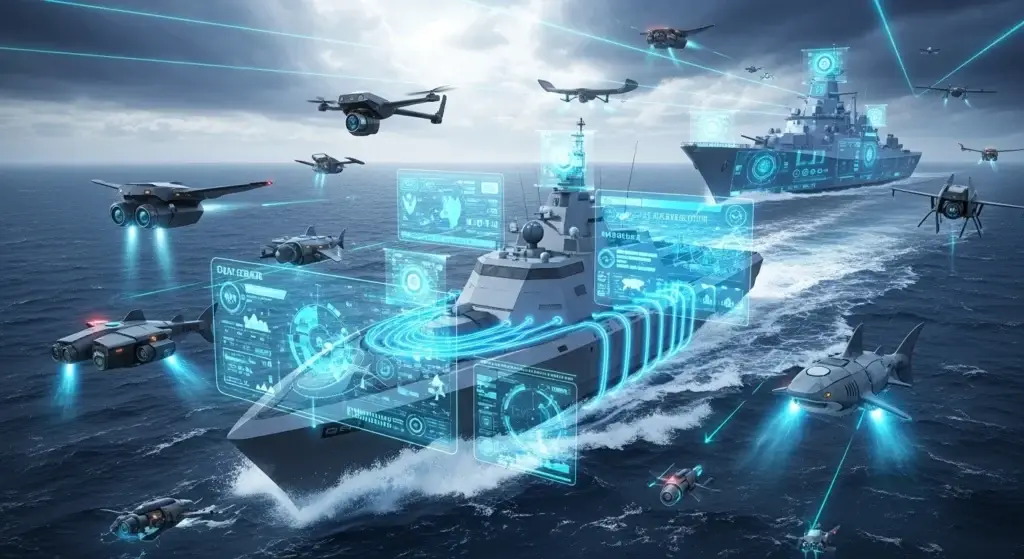
Autonomous Naval Vessels Warfare operates through four integrated layers:
- AI Command & Decision Layer Reinforcement learning and agentic AI enable independent mission execution, real-time re-tasking, and swarm coordination. U.S. MASC vessels now operate with Level 4–5 autonomy in GPS-denied environments.
- Maritime Domain Awareness Technology Multi-spectral sensors (radar, IRST, ESM, SAR) fused with satellite, cyber, and off-board drone feeds create a persistent, real-time battlespace picture. AI algorithms predict adversary intent and prioritize threats.
- Modular Payload & Effector Layer Rapid-swap modules for strike (hypersonic anti-ship weapons impact), electronic warfare, mine laying, and anti-submarine warfare. This gives autonomous platforms unmatched flexibility.
- Resilient Communications & Survivability Layer Mesh networking, satellite backups, and airborne/satellite relays ensure connectivity even when primary channels are jammed.
Key platforms in 2026:
- USA — MASC family (Sea Hunter, Seahawk) with modular strike and EW payloads.
- China — Type 076 drone carrier + large USV/UUV fleet.
- Ukraine — Ocean-capable Magura/Sea Baby variants.
- Russia — Poseidon nuclear UUV for strategic deterrence.
These systems cost 10–30% of traditional warships while delivering weeks-long endurance and trans-oceanic reach.
For technical depth on autonomy software, see the RAND Corporation report on naval unmanned systems.
Strategic Importance
Naval AI integration is reshaping maritime power by enabling distributed lethality at scale. A single carrier strike group augmented by dozens of autonomous warships can cover vastly larger ocean areas, absorb initial losses, and maintain pressure without risking high-value manned hulls. This directly supports sea control doctrine 2030, submarine deterrence doctrine, and anti-ship missile systems analysis.
In the Indo-Pacific, autonomous platforms counter China’s numerical advantage and A2/AD strategy. In the Black Sea and beyond, Ukraine’s sea drones have already forced major fleet repositioning. For smaller navies, autonomous naval vessels warfare offers asymmetric deterrence without massive capital investment.
Doctrinally, navies are moving from platform-centric to hybrid AI-centric fleets. The manned capital ship becomes the command node; autonomous warships become the effectors. This evolution links directly to cyber resilience, sensor fusion, and AI multi domain operations explored in our previous cluster articles.
Real-World Examples
Ukraine’s Black Sea Campaign (2022–2026)
Ukraine’s AI-enhanced Magura and Sea Baby naval drones have sunk or damaged multiple Russian warships, forcing the Black Sea Fleet into defensive posture. The 2026 evolution to long-range ocean-capable drones demonstrates how naval AI integration turns low-cost platforms into strategic weapons. Detailed analysis is available in the IISS Strategic Dossier on Maritime Unmanned Systems in Ukraine.
U.S. Navy MASC Operational Deployment (January 2026)
Sea Hunter and Seahawk are now integrated into carrier strike groups for ISR, EW, and strike missions — the first real-world validation of autonomous naval vessels warfare alongside capital ships.
China’s Type 076 Commissioning Path
The Sichuan’s successful sea trials and planned 2026 commissioning position China as the leader in drone-carrying amphibious platforms, expanding unmanned aviation reach across the Western Pacific.
Expert-Level Analysis
Strengths
- Affordable mass and attritability
- Risk reduction for crews
- Persistent presence in contested waters
Weaknesses & Limitations
- Vulnerability to advanced electronic warfare and hypersonic anti-ship weapons
- Command-and-control challenges in contested spectrum
- Ethical and legal questions around fully autonomous lethal force
Countermeasures
- Layered defenses (EW + directed energy + kinetic interceptors)
- Human-on-the-loop oversight protocols
- Redundant multi-path communications
For quantitative assessment, refer to the CSIS analysis on naval unmanned systems and maritime competition.
Future Warfare Impact
By 2030, autonomous warships will constitute 30–45% of major surface fleets. Hybrid manned-unmanned task forces will dominate maritime operations, enabling persistent forward presence at lower cost and risk.
Future warfare prediction: In a 2030–2035 Taiwan or South China Sea contingency, Chinese Type 076 drone carriers and USV swarms will create distributed maritime denial zones, while U.S. MASC and Ghost Fleet platforms counter with resilient sensor networks and multi-domain effects. The side that maintains effective command-and-control under cyber and kinetic pressure will control sea lines of communication and determine the outcome of the campaign.
Global investment in naval autonomous systems is projected to exceed $50 billion annually by 2030.
Comparison Section: Autonomous Warships Leadership 2026–2030
| Nation | Key Platform | Autonomy Level | Operational Status 2026 | Scale Projection 2030 | Overall Lead |
|---|---|---|---|---|---|
| USA | MASC / Sea Hunter | 4–5 | Fleet deployment | High | Integration & doctrine |
| China | Type 076 + USV/UUV fleet | 4+ | Commissioning path | Very High | Scale & speed |
| Russia | Poseidon UUV | 3–4 | Limited testing | Medium | Tactical focus |
| Ukraine | Sea Baby / Magura evolution | 4 | Operational in combat | Growing | Asymmetric innovation |
Key Takeaways
- Naval AI integration is the decisive enabler of future maritime combat systems.
- Autonomous warships deliver affordable mass, risk absorption, and persistent presence.
- USA leads in integration maturity; China leads in scale and deployment speed.
- Ukraine’s Black Sea success proves low-cost autonomous systems can challenge major navies.
- Submarine deterrence doctrine and anti-ship missile systems analysis are being rewritten by unmanned platforms.
- Maritime domain awareness technology and sea control doctrine 2030 now depend on resilient AI command links.
- Nations must accelerate investment in modular autonomy, resilient C2, and hybrid fleet architectures immediately.
Conclusion
AI is transforming naval warfare by turning autonomous warships into the backbone of future maritime combat systems. By 2030, hybrid fleets combining manned capital ships with AI-enabled autonomous platforms will determine maritime superiority and control of the world’s critical sea lanes.
The global race is intensifying. Nations that master naval AI integration, autonomous naval vessels warfare, maritime domain awareness technology, and sea control doctrine 2030 will shape the maritime balance of power for decades. Those that hesitate will find themselves strategically outmaneuvered in contested waters.
FuturWave.com remains the leading platform for authoritative analysis of future warfare. Defense leaders, naval commands, and industry partners seeking detailed autonomous warship assessments, scenario modeling, or strategic integration briefings are invited to engage directly — the AI naval revolution is already at sea, and the winners are being decided now.
How is AI transforming naval warfare in 2026?
AI enables autonomous decision-making, real-time sensor fusion, and swarm coordination on unmanned surface and underwater vessels, turning them into distributed force multipliers.
What are the main autonomous warship programs in 2026?
U.S. MASC (Sea Hunter), China Type 076 drone carrier, Ukraine ocean-going Sea Baby/Magura, and Russia’s Poseidon UUV.
Can autonomous warships replace traditional manned fleets?
No. They serve as force multipliers in hybrid fleets, extending reach and absorbing risk while manned platforms retain command roles.
What risks do AI-driven naval systems introduce?
Cyber vulnerabilities, command failures in contested spectrum, and escalation risks from autonomous lethal decisions.
How will maritime power projection change by 2030?
Distributed hybrid fleets with autonomous platforms will dominate, enabling persistent operations at lower cost while integrating air, cyber, and space domains.