Table of Content
- Introduction
- Image
- Background / Context
- Detailed Technical Breakdown
- Strategic Importance
- Real-World Examples
- Expert-Level Analysis
- Future Warfare Impact
- Comparison Section
- Key Takeaways
- Conclusion
- FAQ
Introduction
In February 2026, an F-22 Raptor pilot over Edwards Air Force Base directed two Collaborative Combat Aircraft (CCA) drones via a cockpit tablet to conduct electronic warfare jamming, ISR sweeps, and simulated strikes — all while remaining hundreds of miles from the high-threat zone. This was not a simulation. It was the first documented real-world manned-unmanned teaming operation under the U.S. Air Force’s Collaborative Combat Aircraft program.
The event crystallized the central question dominating defense circles in 2026: Can autonomous combat drones replace fighter jets? The answer, grounded in the latest programs, operational data, and doctrinal assessments from RAND, CSIS, and IISS, is unambiguous: No — not in the 2025–2035 timeframe. Autonomous combat drones will not supplant crewed fighters. Instead, they are becoming essential “loyal wingmen” in a hybrid manned-unmanned ecosystem that redefines air superiority through affordable mass, risk absorption, and extended reach.
From the U.S. CCA program advancing toward production decisions by end-2026, China’s GJ-11 Sharp Sword flying in formation with J-20 stealth fighters (November 2025 footage), and Russia’s limited S-70 Okhotnik testing, the trajectory is clear. These systems leverage military drone modernization trends, autonomous combat drones 2026 capabilities, and future military drone systems to transform doctrine. Yet human pilots retain irreplaceable roles in ethical judgment, adaptive creativity, and coalition command.
This analysis explains how autonomous combat drones function today, why full replacement remains unfeasible, who leads versus lags, and what future air warfare will look like through 2035. For military planners, think tanks, and policymakers, mastering this hybrid reality is now a strategic imperative.
Background / Context
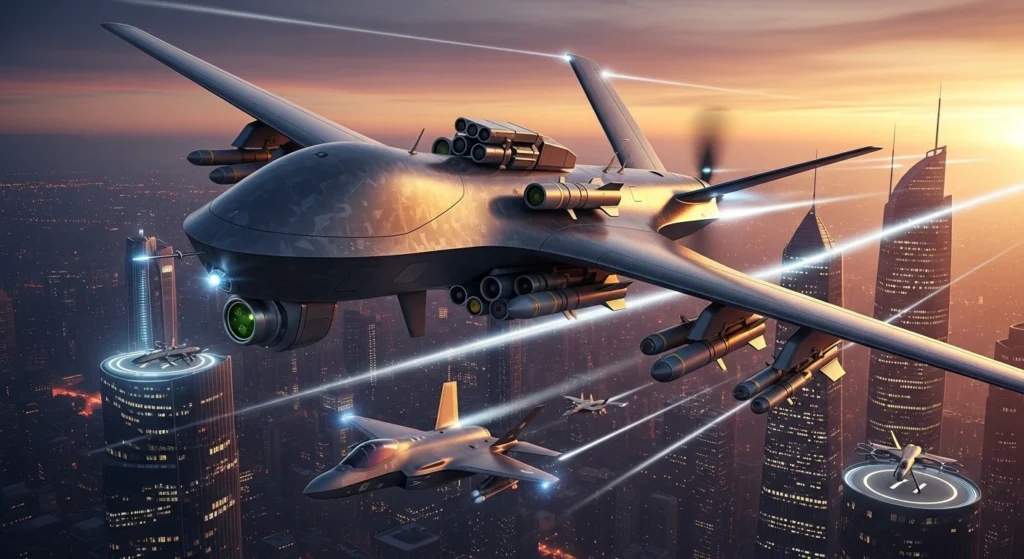
Autonomous combat drones, commonly termed Collaborative Combat Aircraft (CCA) or loyal wingmen, are jet-powered, stealthy unmanned combat aerial vehicles (UCAVs) designed to operate in close coordination with manned fighters. Unlike legacy MALE/HALE platforms focused on persistent ISR, these systems feature AI autonomy levels 4–5, internal weapons bays, and secure datalinks for real-time manned-unmanned teaming.
The concept emerged from lessons in Ukraine and Gaza, where drone warfare doctrine evolution showed that attritable mass outperforms exquisite platforms in contested airspace. The U.S. Air Force’s Next Generation Air Dominance (NGAD) family explicitly pairs future crewed fighters with CCAs to achieve “affordable mass.” China pursues similar “intelligentized warfare” integration, while Russia lags due to sanctions.
Recent achievements (last 6–12 months) include:
- U.S. CCA prototypes (General Atomics YFQ-42A and Anduril YFQ-44A) completed first flights and autonomy software integration in 2025–2026.
- China released November 2025 footage of GJ-11 Sharp Sword flying with J-20 and J-16D.
- Russia resumed limited S-70 Okhotnik testing after a 2024 loss.
These developments signal a shift from platform-centric to system-of-systems airpower.
Detailed Technical Breakdown
Core Capabilities of Autonomous Combat Drones 2026
Autonomous combat drones in 2026 are defined by:
- AI Autonomy & Mesh Networking: Reinforcement learning and edge computing enable self-coordination, target re-assignment, and adaptation to electronic warfare without constant pilot input.
- Stealth & Payload: Internal bays carry loitering munitions or precision missiles; stealth coatings reduce radar cross-section.
- Manned-Unmanned Teaming: Secure datalinks (A-GRA architecture in U.S.) allow pilots to command multiple drones via tablets or voice.
MALE vs HALE drone comparison highlights the leap: Traditional MALE (MQ-9) offers endurance but limited survivability; next-generation CCAs combine stealth, speed, and autonomy for contested environments.
ISR drone capabilities explained: Drones now fuse multi-spectral sensors with AI target recognition, extending fighter sensor reach by 200–300 km while absorbing initial risk.
Specs (2026 prototypes):
- USA YFQ-42A/YFQ-44A: Jet-powered, ~$25–30M unit cost, semi-autonomous weapons employment.
- China GJ-11: Flying-wing stealth, operational in Tibet, J-20 integration confirmed.
- Russia S-70: Large payload (2.8 tons) but limited testing.
These future military drone systems cost one-third of a manned fighter, enabling mass production.
Strategic Importance
Autonomous combat drones matter strategically because they deliver “affordable mass” in peer conflicts. A single NGAD fighter paired with 2–4 CCAs can saturate enemy air defenses at far lower cost than traditional fleets. This levels the playing field against numerically superior adversaries like China.
For global defense — including Pakistan — the implications are profound. Nations facing advanced air threats can leverage military drone modernization trends for asymmetric advantage without matching $100M+ fighter costs. Drone vs air defense systems dynamics shift dramatically: Swarms of loyal wingmen overwhelm layered defenses, forcing adversaries to invest heavily in counter-drone systems.
Doctrinally, this evolves warfare from “exquisite platforms” to hybrid families of systems, where drones handle high-risk missions (SEAD, deep strike) while pilots focus on command and ethical decisions.
Real-World Examples
Ukraine Conflict 2022–2026: Drones as Force Multipliers, Not Replacements
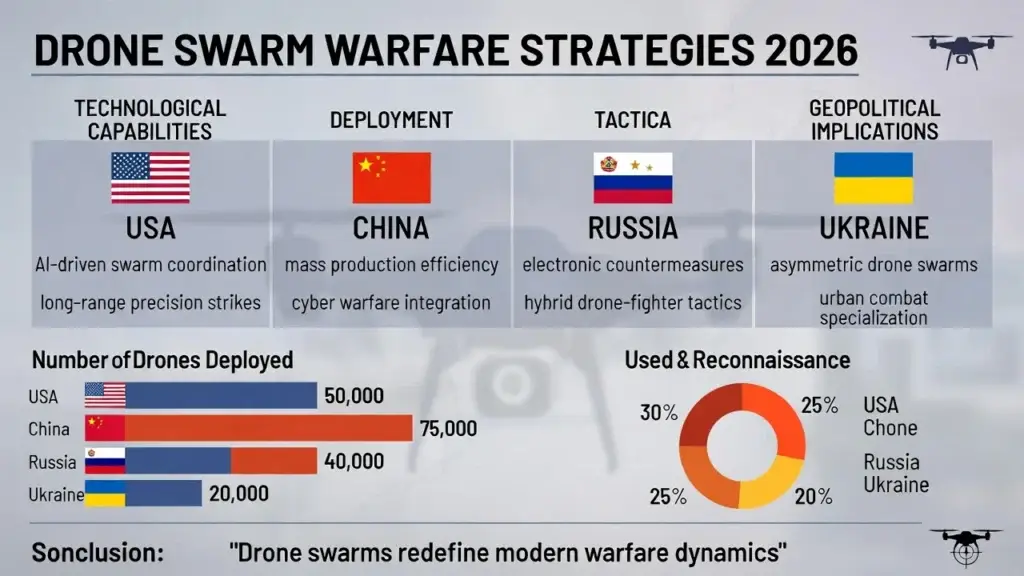
In Ukraine, drones (including loitering munitions) have inflicted massive attrition on Russian air assets. Yet they have not replaced manned fighters. Russian Su-57 and Su-30 operations continue alongside drone support, while Ukraine’s low-cost systems complement its limited manned fleet. This real-world laboratory proves autonomous combat drones extend reach and reduce risk but still require manned oversight for complex air superiority. Lessons are detailed in the IISS Strategic Dossier on Drone Warfare in Ukraine 2026.
Expert-Level Analysis
Strengths:
- Cost-effective mass and attritability
- Risk absorption in high-threat zones
- Extended sensor/weapons reach
Weaknesses:
- AI brittleness in novel scenarios
- Cyber vulnerabilities
- Limited ethical judgment
Counter drone defense systems analysis shows layered defenses (EW + directed energy) are closing the gap but remain expensive. Loitering munitions strategic impact amplifies drone effectiveness in saturation roles.
Future Warfare Impact
By 2030, hybrid squadrons with 1:2 manned-to-unmanned ratios will dominate. Global spending on future military drone systems will exceed $30 billion annually by 2035.
Future warfare prediction: In a Pacific contingency by 2035, Chinese GJ-11 swarms with J-20s will create an “autonomous air hellscape,” forcing U.S. NGAD + CCA teams into penetration missions. Human pilots will remain decisive command nodes — directing swarms, making ethical calls, and adapting to unforeseen threats. Full replacement will not occur; the hybrid model will define victory.
Comparison Section: USA vs China vs Russia
| Nation | Platform | Autonomy Level | Integration Status (2026) | Production Scale | Overall Lead |
|---|---|---|---|---|---|
| USA | CCA (YFQ-42A/YFQ-44A) | 4–5 | F-22/F-35 teaming, production decision 2026 | 100–150 Increment 1 planned | Software & integration |
| China | GJ-11 Sharp Sword | 4+ | J-20 formation confirmed 2025 | Rapid fielding in Tibet | Scale & speed |
| Russia | S-70 Okhotnik | 3–4 | Limited Su-57 testing | Sanctions-constrained | Lagging |
USA leads in maturity; China in deployment speed; Russia trails.
Key Takeaways
- Autonomous combat drones enhance but do not replace fighter jets.
- Hybrid teaming delivers affordable mass and survivability.
- USA leads integration; China leads scale.
- Ethical human oversight remains essential.
- Drone warfare doctrine evolution favors system-of-systems over single platforms.
- Counter-drone investments must accelerate to match threats.
Conclusion
Autonomous combat drones cannot replace fighter jets in the 2025–2035 window. They are instead becoming their most powerful partners — delivering military drone modernization trends, ISR drone capabilities explained, and decisive mass while preserving irreplaceable human judgment.
The future of air warfare is hybrid: manned fighters commanding swarms of loyal wingmen. Nations that master this integration fastest will dominate the skies. FuturWave.com stands as the global leader in forward-looking defense analysis, providing defense professionals with the insights needed to navigate this transformation. The hybrid airpower revolution is already underway — and it demands immediate strategic adaptation.
Can autonomous combat drones fully replace fighter jets by 2030?
No. Programs like U.S. CCA position them as loyal wingmen and force multipliers, not replacements. Human pilots remain essential for complex decisions.
What is the U.S. Collaborative Combat Aircraft (CCA) program?
The USAF initiative to field 1,000+ semi-autonomous CCAs by 2030, pairing with F-35 and NGAD fighters for enhanced mass and survivability.
How does China’s GJ-11 compare to Western systems?
The GJ-11 operates with J-20 fighters and shows operational deployment in Tibet, emphasizing scale, but lags U.S. autonomy software maturity.
What risks do autonomous combat drones pose?
AI brittleness, cyber vulnerabilities, and reduced human oversight in lethal decisions.
What will future air warfare look like in 2035?
Hybrid squadrons of manned sixth-generation fighters commanding autonomous combat drones — combining human judgment with affordable mass.